
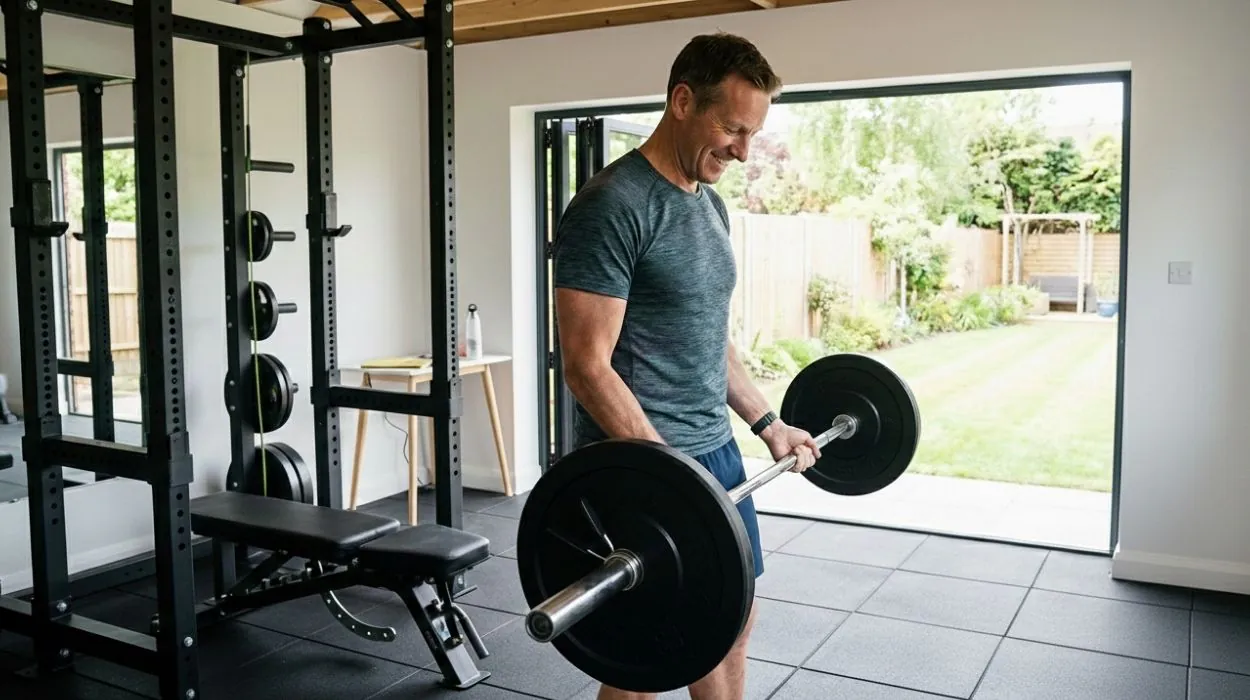
For the modern man in their 40s, 50s and 60s, the greatest obstacle to physical progress is rarely a lack of willpower; it is a lack of time. Between high-stakes career demands, family logistics, and the need for adequate recovery, the traditional “gym experience” can become a source of friction rather than a sanctuary for strength.
The commute, the search for parking, the wait for a squat rack, and the distractions of a commercial environment all add a hidden tax to your training. In the Over Lifestyle, we value efficiency as a pillar of longevity. If your environment does not support your goals, you change the environment.
Put simply: a home gym for men over 40 isn’t a luxury project. It’s infrastructure for staying strong enough to live the life you care about. For many men over 40, it is a strategic decision: remove friction, protect your time, and make strength training easier to sustain across decades.
The Myth of the “Home Workout”
When many men think of training at home, they picture light dumbbells, generic cardio apps, or “toning” routines. That picture is badly out of date.
To maintain and build strength and muscle as you age, you need mechanical tension and progressive overload. You do not need a 2,000-square-foot facility to get that. You need the right tools, used with intent.
Well-structured home-based strength training can effectively build long-term strength and muscle, provided the programme is built around the same principles: progressive loading, enough volume, and respect for recovery. This doesn’t mean every home plan is equal — it means the principles matter more than the location.
In other words: it’s not the building that makes you stronger. It’s the work you do inside it.
Home vs Commercial Gyms: Not Either–Or
None of this means commercial gyms are “bad” or that you should abandon yours if you enjoy it.
A good gym can offer access to heavier weight, heavier fixed loads and machines, and a change of environment. For some men, that mix is motivating. For others, it becomes another logistical burden.
The home gym is best seen as an additional tool, not a replacement for everything else. Many Over Lifestyle readers find a blended approach works well: home for efficient strength sessions for busy weeks, and commercial gym sessions for heavier barbell work, specific machines, or simply a reset in environment.
The point is choice and control. When training depends on opening hours, rush hour, and equipment availability, consistency suffers. When you can also train at home, you are no longer at the mercy of anyone else’s timetable.
The Zero-Friction Protocol: Why Home Wins
The primary advantage of a home gym is the removal of barriers.
1) Reclaiming the “Time Tax”
A typical commercial gym visit can easily take 90–120 minutes once you include travel, parking, changing rooms, and waiting for equipment. A home session can start and finish in 35–45 minutes.
For a busy man over 40, that difference is often the gap between training three times per week and not training at all.
2) A Recovery-Friendly Environment
In our guide to managing stress and recovery after 40, we talk about how your nervous system can spend too much time in a “switched on” state. If your broader life is already high stimulation, the gym can add to that load: loud music, bright lights, crowds, and constant movement. At home, you control the atmosphere. A quieter, more predictable training environment is often easier to sustain, especially when training is meant to support your life rather than dominate it. That makes it easier to move from “hard effort” into genuine recovery once the session ends.
3) Focus and Privacy
There is a quiet psychological advantage to training in a space where you are the only client.
You can take the time you need to set up a lift, focus on technique without feeling watched or allowing “ego lifting” to creep in, and run your own structure without waiting for equipment. For men returning after time away, that privacy can be the difference between getting started and staying stuck.
Choosing Your Home Gym Path
To make home training work, you do not need an entire warehouse of kit. You need a small number of tools that let you load the main movement patterns progressively.
For most men over 40, there are two main paths.
Path A — The Minimalist Strength Setup (Adjustable Dumbbells First)
This is the default starting point for many men: serious, joint-conscious strength training in a normal house or flat, without dedicating a full room to equipment.
At minimum, you should aim for:
Adjustable dumbbells
A single pair that can move from light to challenging loads. They replace a full rack of fixed dumbbells and allow you to train every major pattern: squats, hinges, presses, rows, and carries.
A sturdy adjustable bench
Helps you press, row, and support your body in joint-friendly positions. It also opens up a wide range of upper-body options if barbell work isn’t practical.
A stable lifting surface
A simple mat or small lifting platform protects floors and adds confidence for heavier dumbbell work.
With just these pieces, you can run months of effective training:
- Goblet squats and split squats for lower body
- Romanian deadlifts and hip hinges for the posterior chain
- Bench and floor presses, overhead presses, and push variations
- Supported rows and single-arm rows for the upper back
- Farmer’s carries and suitcase carries for grip and trunk strength
For new and returning lifters, or anyone who prioritises joint-friendliness and simplicity, this path alone is more than enough to build meaningful strength.
Path B — The Barbell Strength Lab (Rack + Barbell)
This path suits men who either:
- Already have a long training history with barbells
- Want to push heavier squats, deadlifts and presses over time
- Have a garage or room they are happy to dedicate as a “Strength Lab”
The core pieces are:
A rack or solid squat stands
Your safety net for squats, presses, and rack pulls. Look for equipment you trust under load.
An Olympic barbell and plates
Still the most direct way to apply progressive overload to heavy compound lifts. Ideal for those who enjoy working with clear numbers and steady progression.
A bench
For barbell and dumbbell pressing, as well as supported rows and other assistance work.
Even in a barbell-focused setup, adjustable dumbbells and resistance bands remain extremely useful for assistance work, joint-friendly variations, and lighter sessions.
You do not have to choose one path forever. Many men start with Path A, build consistency and confidence, then add barbell equipment later if and when it makes sense for their goals, space, and budget.
Designing for Success: The Professional’s Workspace
Whether you build a minimalist dumbbell corner or a full rack-and-barbell setup, the space matters.
Lighting and Air Quality
Aim for a space that feels inviting, not oppressive. Natural light where possible, decent ventilation, and enough brightness that early morning and late evening sessions feel safe and straightforward.
You are more likely to train in a room that feels clean and breathable than in a dark storage area.
The Logbook Station
Training at home requires more self-accountability than training in a coached environment. A simple notebook or notes app, kept in the same place, turns each session into a continuation rather than a standalone event. Recording exercises, sets, reps, and a brief note on how the session felt creates a training history you can build on. How to track progression without overthinking it is covered in our article about progressive overload.
Visual Cues and Boundaries
If possible, avoid turning your home gym into a dumping ground. Keep clutter minimal, avoid screens that invite scrolling or work emails, and store only what supports the session.
When you step into that space, the message should be clear: this is where you train.
The Consistency Advantage
Research on exercise adherence repeatedly shows that convenience and proximity are strong predictors of long-term consistency. When the gym is an extra journey, you rely on motivation. When the gym is twenty steps away, you rely on a habit.
This is also where the home gym shines for “minimum effective dose” training. On days when work is overwhelming or sleep has been patchy, you can still do something meaningful. A short session, such as a 30-minute total body session, keeps the habit alive without turning training into a second job.
Over months and years, the ability to “do something instead of nothing” is often what separates men who stay strong from those who drift away from training.
Conclusion: Investing in Your Infrastructure
In mid life, your physical capability is one of your most valuable assets. The equipment in your home gym — whether it’s a pair of adjustable dumbbells and a bench or a rack and barbell — is infrastructure that protects that asset.
Commercial gyms still play a role. They can complement and build on your home setup rather than compete with it. But by removing friction, queues, and crowded spaces, a home gym turns “I don’t have time” into “I’ve already finished”.
Building a home gym is not about chasing perfection. It is a quiet statement of intent: your health matters enough to have its own space, your training matters enough to be convenient, and your future self matters enough to invest in now.
The best gym in the world is the one you will use — week after week, year after year.
Over Lifestyle Sign-Off
Smart. Sustainable. Strong for Life.
Over Lifestyle
Disclaimer
This article provides general information for educational purposes only. It is not medical advice, and it is not a substitute for professional assessment or guidance. If you have health concerns, you may wish to consult a qualified healthcare professional before starting or changing an exercise routine.
This article also does not provide structural, engineering, or safety certification advice. If you are setting up heavier equipment (such as racks, barbells, or loaded storage) you are responsible for checking flooring suitability, load-bearing limits, installation requirements, and safe equipment use. Where appropriate, consider consulting a qualified professional regarding home setup and equipment safety. [Read Our Full Disclaimer].